Thursday, May 10, 2007

Further On

While I haven't written anything in over a month, there has been a bit of progress made, some of which is rather mundane. I spent a good while straightening strips and dressing nodes in bits and spurts. In between the bits and spurts fishing beckoned, and so progress has slowed significantly.

Although I had already dressed the nodes while the culm was whole, more accurate attention can be given to each one as part of a thin strip.


I used my trusty 8" mill bastard file to flatten the nodes. This was a bit of an experiment for me. In the past I have used heat and pressure from a vice to squish the enamel side of the node flat. This method has given me fits, and I suspect that in an effort to preserve power fibers I am compromising the structual integrity of the node by applying so much pressure. So for these rods I am carefully addressing each node with the file instead of heat and pressure.


After dressing each node I straightened every strip using heat from a heat gun in preparation for another experimental process: the beveller.

Here's a preview of things to come

Wednesday, April 4, 2007

Research

I have not been doing much on the project recently. I have been finishing up another rod (a 7'9" 5 wt.) and have been busy with other things, too.
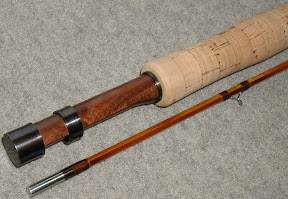
Nevertheless, I felt that progress, even slow progress, should not be impeded. To that end I spent some time searching the rodmaker's archives for posts that Ted had made while active on the listserv. I actually gleaned quite a bit from these posts. Some of the posts were amusining banter, while others provided insight.

I found it interesting that some of the things that I have been toying with recently are similar to what he had done in the past. One example that comes immediately to mind are my recent experiments with shellac on silk wraps. I have gotten a lot of great advice (including "don't use it!"--a valid assessment), help, and even some material to experiment with (thank you David). I still have to speak to a couple of people and try a great many more things with shellac on wraps, but I have learned quite a lot.
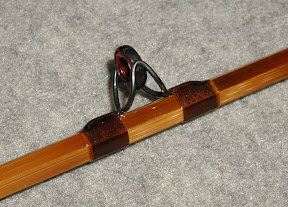
Mostly consisting of how much more I have to learn. There is no substitute for experience. There are no shortcuts to quality.

I diligently work towards both, learning volumes with each new rod.

My apparent digression is actually a springboard to what I found between the lines of Ted's posts. About halfway through my readings I realized that Ted never stopped experimenting with new techniques or processes. He certainly had many "tried and true" methods that he shared with others, but he also explored other avenues within the craft.

On one hand I hope that I always maintain that level of interest, creativity, and open-mindedness.

On the other, I would finish rods a whole lot faster if I would stop goofing around with different techniques and just build the things.

But that's the experience part. Hopefully that's the part that will pay dividends down the road. The part that will allow me to make informed decisions as to why I do something the way I do. The part that will enable me to say "yes, I tried 'x, y and z', but they didn't work out for me."
Sometimes research isn't just looking up others' information. Sometimes it is getting your hands dirty and trying something out yourself. At least it is for me.

Thursday, March 29, 2007

Pick Up Sticks!

After assigning strips to their various locations I needed to establish a node staggering pattern. I have not settled on one particular pattern and tend to experiment with different node spacings. For these rods the decision was rather easy, as Ted used a 2x2x2 spacing. To do this it was important to put the strips for each section in the order they will end up in the rods.

Once they were oriented properly, I measured the inter-nodal space about midway along the strip and divided by 3. This gave me the distance that I should slide adjacent strips (the distance between nodes). I added some length to the strips before cutting them to give myself some breathing room when working on them. Plus I can use the scraps from the blanks for beads, dubbing needle handles and the like. I then marked the ends of the strips to be cut to working length.

Then I started cutting.

As the work session wore on, 72 end cuts hit the floor... Pick up sticks! Every time I do this I tell myself I need a band saw.

After making all of those cuts I began removing what remained of the nodal dams. A short bench plane makes short work of them.

By the day's end, I had managed to keep everything in order.

And 36 strips of bamboo were all the same length, looking much neater but still nothing like a fishing rod.

I bundled and labeled them all once again to be kept safe until next time.

Wednesday, March 14, 2007

Splitting

Taking a relatively beefy bamboo culm and splitting it lengthwise into several narrow sections more or less starts the physical process of working a chunk of grass into a flyrod or two (I have heard of one maker squeezing seven out of a large diameter culm by being frugal and scarfing scraps together!). If I get the two I am after, I will be a pretty happy guy.


I first split the butt sections into quarter-inch wide strips. Moving on to the tip sections, I split a bit narrower in order to squeeze more strips out of the culm and reduce the amount of excess planing that I do. To make a split, I first mark the culm where I would like it to split. I then align a knife on the very end so that it is perpendicular to the outside of the culm's diameter. When I am happy with the alignment I rap the knife with a rubber mallet to initiate the split. I then remove the knife and more or less "rip" the bamboo apart using my fully-gloved hands (this stuff is SHARP!).

Before I made my very first rod I completely destroyed a culm of bamboo trying to learn to do this. It was frustrating, but with a bit of guidance I was able to do much better on the second culm. Now I don't find it difficult, but I remember how I felt looking at all of those splinters on the floor!

Perhaps more interesting (perhaps less) is the way in which I decided to number and
bundle the strips for each rod. Sometimes there will be a stronger and weaker "side" to a culm of bamboo having to do with the conditions it was grown under and who knows what else. This is the subject of great debate. Come to think of it everything is the subject of great debate among rodmakers.

Endeavoring to match the rods as closely as possible and keep the splines "balanced," I chose strips from all sides of the culm, first for Lisa's rod. In other words, if you were to divide a cross section of the bamboo into six parts, I took one strip from each part. Then I chose adjacent strips to those for my version. From this point on, all of the strips need to be kept in the proper order, so I numbered everything using a system that makes absolutely no sense to anyone but me. System is probably a strong word, actually.

Once I had chosen and labeled all of the strips I bound them into bundles to simply keep them managable. The next step (and post) will be to establish proper node staggering and cut all sections to working length.

Wednesday, March 7, 2007

Sister Seat

After deciding that I would make two of these rods my mind turned to what the seat for the sister rod would be. I found a nice insert that I had turned down a couple of years ago and hadn't yet made a rod for it. This seemed like an excellent opportunity to use a pretty (and gnarly) piece of wood. In a similar "that works out well" fashion to the bamboo selection, as it turns out the blank I turned this filler from came from the very same rodmaker's gathering.
From TK Rod Project
I like the poetics of that enough to work around the fact that making the up-slide/hidden-pocket out of an already turned round filler could prove problematic. But I have some ideas for that, and think that it will add a touch of uniqueness in the end.

Tuesday, March 6, 2007

Culm Selection and Burning

Selected Culm From TK Rod Project

When the time came to select a culm to use for these rods my selection was somewhat limited--I had unloaded much of my bamboo when I moved into a tiny apartment a couple of years ago. Out of the 3 culms I had left after the move (all of which were nice), I had given one away, and now had two to choose from. I selected one of them, then realized I had chosen a culm selected from a Demarest Bale "lottery" at the very Gathering that Lisa had made her impression on Ted. If you believe in poetics, this at least sounds like it should have some meaning.

After selecting the culm (which had already been cut into two, six-foot sections) I set to work filing the nodes with an eight-inch mill bastard file.
Before From TK Rod Project
After From TK Rod Project

I did not file them completely flat, but dressed them smooth and took the majority of the nodal bumps out.

The next task was to flame the sections. This should have been a fairly straightforward process, and it is one I enjoy. Unfortunately for me, my particular climate did not present the opportunity--Here in Erie we had 33 consecutive days with measured snowfall in January and February, and most of this time was spent in the teens. My attempts to flame were consistently foiled. When the temps were more moderate it was snowing. When the snow took its work-day breaks the temps seemed to dip down further.

When I finally found a decent window to torch the culm, I opted to use MAPP gas. Normally I use propane, but the MAPP burns hotter, and I believed this would counteract the colder conditions.
From TK Rod Project

The bottom half of the culm is represented by the two sections on the left, and this will make up the strips for the butts of the rods. Tips on the right. The culm looks much darker now than it will when the rod is finished. This actually was a fairly light flaming that when finished should have a nice tight mottling... similar to my cat, only thinner.
From TK Rod Project
From TK Rod Project

Monday, March 5, 2007

The Details

Someone recently asked me what my favorite part of the process of building a rod is. After a bit of consideration I answered that my favorite part was thinking about how the rod would look, imagining how it would cast, and placing myself into the future with premonitions of fish that would be caught.

Some of the most important aspects of building a rod come from the planning (and the planing!) stages. So I began asking Lisa what some of the details of the rod should be, as the same three best parts would likely apply to her, as well. After deciding on the taper, we thought it would be a good plan to use much of Ted's styling preferences. There will likely be some deviations, and these will be due to Lisa's aesthetics and my building methods. With that in mind we came up with the following list:

Taper: Ted Knott’s Ontario Classic taper based off of the Payne 98
7’ 4 wt. 2pc, 2 tip

Color: Tortoise-Shell flaming to compliment the color and character of the reel seat. This is what Ted reputedly did with most of his rods anyway, and it seems it will work perfectly with the unique seat. Also the treatment I like.

Seat: Ted Knott gift to Lisa. Upsliding NS band and hidden pocket.

Grip: Western Style, Reverse Half Wells

Thread: TBD

Nodes: 2x2x2

The final "Detail" is that we decided that I should build a matching rod for myself. The rod will have the same taper, coloration, node spacing, grip, and come from the same culm of bamboo. The only deviations will be the reel seat and possibly the thread coloration. We both thought it best, as I envision this to be a wonderful rod and would want one anyway. The project will go slower overall, but it just feels right.